
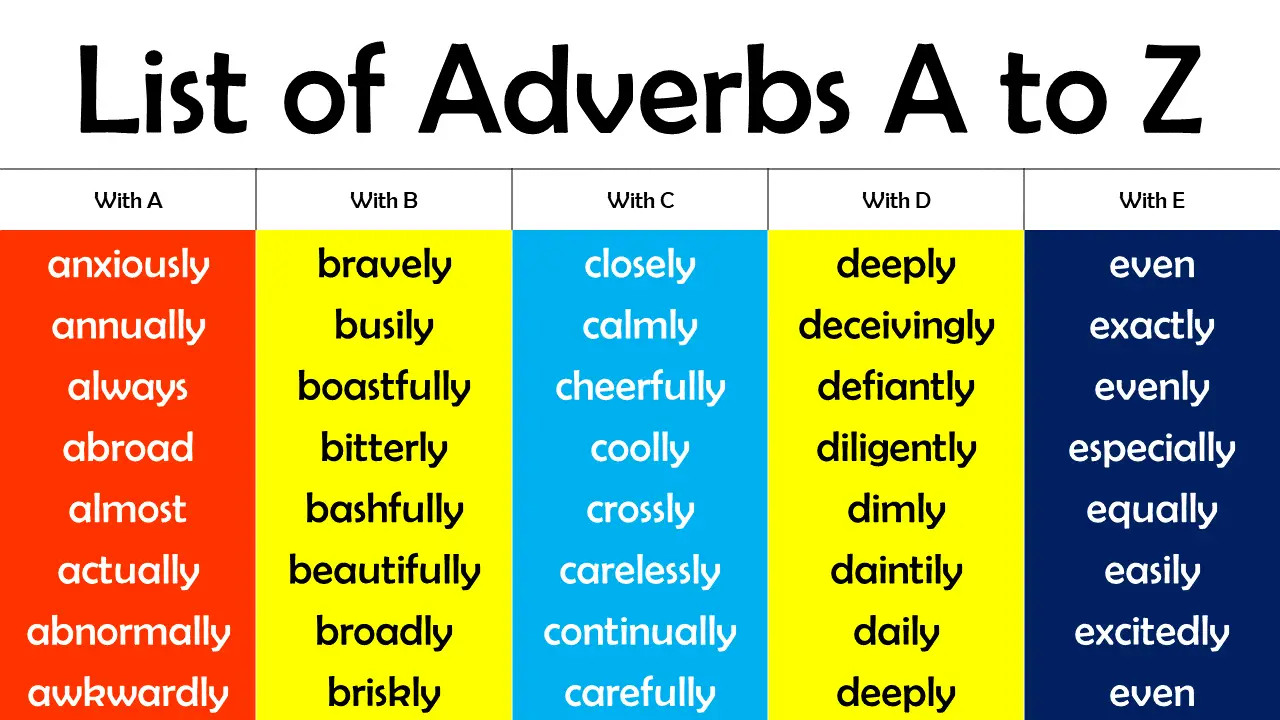
Adverbs are words that describe or modify verbs, adjectives, or other adverbs. They tell us how, when, where, how often, and to what extent something happens.
Example:
She sings beautifully.
He is very tall.
They arrived late.
Adverbs help us make actions clearer and more detailed.
1. WHAT DO ADVERBS DO?
Adverbs give extra information about:
A. Verbs (How someone does an action)
He speaks slowly.
They worked carefully.
B. Adjectives (How strong the adjective is)
She is very happy.
The movie was extremely boring.
C. Other adverbs
He ran very quickly.
She sang quite softly.
2. COMMON TYPES OF ADVERBS
1. Adverbs of Manner (how?)
slowly, quickly, beautifully, badly, loudly
Example: She drives carefully.
2. Adverbs of Time (when?)
now, yesterday, soon, later, today
Example: They will leave soon.
3. Adverbs of Place (where?)
here, there, outside, inside, upstairs
Example: Come here.
4. Adverbs of Frequency (how often?)
always, usually, often, sometimes, never
Example: He always wakes up early.
5. Adverbs of Degree (strength or intensity)
very, too, enough, almost, quite, extremely
Example: The water is too hot.
3. FORMATION OF ADVERBS
Many adverbs are formed by adding –ly to adjectives.
Adjective → Adverb
quick → quickly
careful → carefully
quiet → quietly
Exceptions / Irregular adverbs
- fast → fast
- hard → hard
- early → early
- late → late
- good → well (important!)
Examples:
He runs fast.
She works hard.
You speak English well.
4. POSITION OF ADVERBS
A. Manner adverbs
Usually after the verb or after the object.
She sings beautifully.
He solved the problem quickly.
B. Frequency adverbs
Normally before the main verb, but after ‘be’.
He always arrives early.
They are often hungry.
I never drink coffee.
C. Adverbs of time & place
Usually at the end of the sentence.
We will meet tomorrow.
He looked everywhere.
5. ADVERB VS ADJECTIVE (COMMON CONFUSION)
| Incorrect | Correct | Why? |
|---|---|---|
| She speaks very good. | She speaks very well. | “Well” describes how she speaks. |
| He is a fastly runner. | He is a fast runner. | “Fast” is both an adj + adv. |
| He works hardly. | He works hard. | “Hard” means with effort. “Hardly” means almost not. |
Important note:
Hardly means almost not.
Example: I can hardly see you. (I almost cannot see you.)
6. COMMON ADVERB PATTERNS
A. Too + adverb
He speaks too quickly.
B. Adverb + enough
She runs fast enough to win.
C. Very + adverb
He writes very neatly.
D. Adverb + to-infinitive
She was eager enough to try.
7. EXAMPLES OF ADVERBS IN SENTENCES
- She answered the question politely.
- He arrived late to the meeting.
- They are often busy on weekends.
- The movie ended suddenly.
- She almost finished the work.
8. PRACTICE EXERCISES
A. Fill in the blanks with the correct adverb form
- She sings __________ (beautiful).
- He works __________ (hard).
- They arrived __________ (late).
- She explained the lesson __________ (clear).
- The children ran __________ (quick).
B. Choose the correct option
- He is driving too (fast / fastly).
- She speaks English very (good / well).
- I (always / alwaysly) eat breakfast.
- They are (never / neverly) on time.
- She answered the question (politely / polite).
C. Identify the adverb
- He wakes up early.
- She almost cried.
- They work together.
- He rarely watches TV.
- The train arrived suddenly.
D. Rewrite using correct adverb placement
- He eats quickly his food.
- She always is happy.
- The dog barks loudly in the park.
- We will tomorrow meet.
- They go often to the gym.
E. Change the adjective to adverb
- slow → ________
- angry → ________
- happy → ________
- loud → ________
- careful → ________
ANSWER KEY
- beautifully
- hard
- late
- clearly
- quickly
- fast
- well
- always
- never
- politely
- early
- almost
- together
- rarely
- suddenly
- He eats his food quickly.
- She is always happy.
- The dog barks loudly in the park.
- We will meet tomorrow.
- They often go to the gym.
- slowly
- angrily
- happily
- loudly
- carefully