
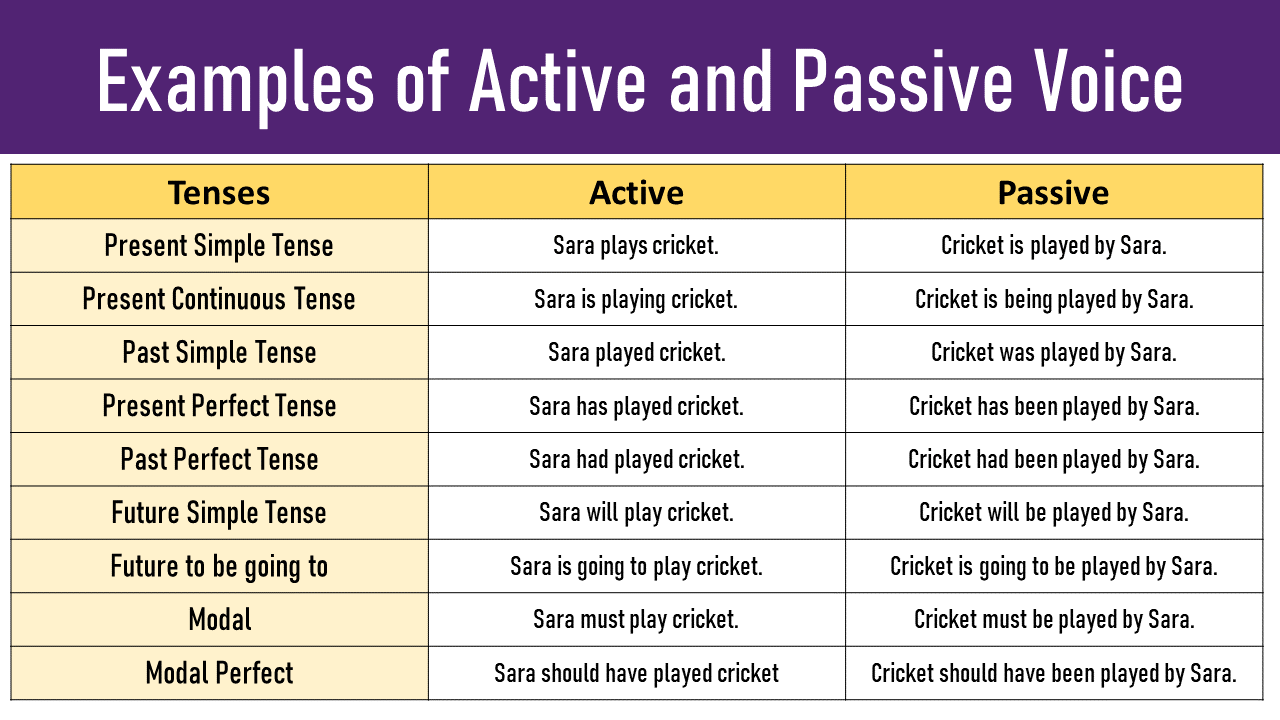
I. WHAT IS VOICE IN ENGLISH?
Voice shows the relationship between the subject and the action (verb).
English has two voices:
- Active Voice
- Passive Voice
II. ACTIVE VOICE
In Active Voice, the subject performs the action.
Structure
Subject + Verb + Object
Examples:
- She writes reports.
- They completed the project.
- He will submit the form.
Active voice is:
- Direct
- Clear
- Preferred in speaking and informal writing
III. PASSIVE VOICE
In Passive Voice, the subject receives the action.
Structure
Object (of active) + appropriate form of be + V3 (+ by + subject)
Examples:
- Reports are written by her.
- The project was completed.
- The form will be submitted.
IV. WHEN DO WE USE PASSIVE VOICE?
Passive voice is used when:
- The doer is unknown
- The doer is unimportant
- The action/result matters more
- Writing is formal, academic, official, or technical
Examples:
- The rules are followed strictly.
- The meeting was postponed.
- The data has been analyzed.
V. GENERAL RULES FOR ACTIVE → PASSIVE
- Only transitive verbs (verbs with objects) can be passive
- Object of active becomes subject of passive
- Main verb becomes V3 (past participle)
- Tense remains the same
- By + agent is optional
VI. ACTIVE → PASSIVE FOR ALL TENSES
1. SIMPLE PRESENT
Active:
- She teaches English.
Passive:
- English is taught (by her).
Formula:
am / is / are + V3
2. PRESENT CONTINUOUS
Active:
- She is teaching English.
Passive:
- English is being taught.
Formula:
am / is / are + being + V3
3. PRESENT PERFECT
Active:
- She has taught English.
Passive:
- English has been taught.
Formula:
has / have + been + V3
4. PRESENT PERFECT CONTINUOUS
❌ NO PASSIVE FORM
(reason: action duration focus, no clear receiver)
5. SIMPLE PAST
Active:
- She taught English.
Passive:
- English was taught.
Formula:
was / were + V3
6. PAST CONTINUOUS
Active:
- She was teaching English.
Passive:
- English was being taught.
Formula:
was / were + being + V3
7. PAST PERFECT
Active:
- She had taught English.
Passive:
- English had been taught.
Formula:
had + been + V3
8. PAST PERFECT CONTINUOUS
❌ NO PASSIVE FORM
9. SIMPLE FUTURE (WILL)
Active:
- She will teach English.
Passive:
- English will be taught.
Formula:
will + be + V3
10. FUTURE CONTINUOUS
❌ RARE / NOT USED IN STANDARD PASSIVE
(“will be being taught” is grammatically possible but avoided)
11. FUTURE PERFECT
Active:
- She will have taught English.
Passive:
- English will have been taught.
Formula:
will have + been + V3
12. FUTURE PERFECT CONTINUOUS
❌ NO PASSIVE FORM
VII. ACTIVE → PASSIVE WITH MODALS (VERY IMPORTANT)
GENERAL MODAL PASSIVE FORM
Modal + be + V3
1. CAN
Active:
- She can solve the problem.
Passive:
- The problem can be solved.
2. COULD
Active:
- He could complete the task.
Passive:
- The task could be completed.
3. MAY
Active:
- They may announce the result.
Passive:
- The result may be announced.
4. MIGHT
Active:
- She might postpone the meeting.
Passive:
- The meeting might be postponed.
5. MUST
Active:
- You must follow the rules.
Passive:
- The rules must be followed.
6. SHOULD
Active:
- We should revise the lesson.
Passive:
- The lesson should be revised.
7. OUGHT TO
Active:
- You ought to complete the work.
Passive:
- The work ought to be completed.
8. WOULD
Active:
- He would explain the topic.
Passive:
- The topic would be explained.
9. SHALL (formal)
Active:
- We shall announce the decision.
Passive:
- The decision shall be announced.
10. USED TO
Active:
- They used to play cricket.
Passive:
- Cricket used to be played.
VIII. MODAL PERFECT PASSIVE (ADVANCED)
Structure
Modal + have + been + V3
Examples:
Active:
- She must have completed the work.
Passive:
- The work must have been completed.
More examples:
- The email should have been sent.
- The rules might have been ignored.
- The report could have been prepared.
IX. COMMON VERBS THAT CANNOT BE PASSIVE
❌ Intransitive verbs:
- arrive
- sleep
- go
- happen
- die
Incorrect:
- ❌ The accident was happened.
Correct:
- ✅ The accident happened.
X. COMMON ERRORS TO AVOID
❌ The work is complete by him
✅ The work is completed by him
❌ English is teach here
✅ English is taught here
❌ The class was teaching
✅ The class was being taught
XI. EXERCISES
A. Change Active → Passive
- She writes reports.
- They are conducting the exam.
- He has completed the work.
- We will announce the result.
- She taught English.
- He is preparing the report.
- They had finished the task.
- She can solve the problem.
- You must follow the rules.
- They may postpone the meeting.
- He should revise the lesson.
- She will have submitted the form.
- We must obey the law.
- They used to play cricket.
- She could answer the question.
B. Fill in the blanks (Passive)
- The work ___ (complete) yesterday.
- English ___ (teach) here.
- The report ___ (prepare) now.
- The form ___ (submit) already.
- The rules ___ (follow) strictly.
- The meeting ___ (postpone).
- The lesson ___ (revise) soon.
- The email ___ (send) by him.
- The exam ___ (conduct) tomorrow.
- The task ___ (finish) before noon.
XII. ANSWER KEY
A. Active → Passive
- Reports are written by her.
- The exam is being conducted by them.
- The work has been completed by him.
- The result will be announced by us.
- English was taught by her.
- The report is being prepared by him.
- The task had been finished by them.
- The problem can be solved by her.
- The rules must be followed.
- The meeting may be postponed.
- The lesson should be revised.
- The form will have been submitted by her.
- The law must be obeyed.
- Cricket used to be played by them.
- The question could be answered by her.
B. Fill in the blanks
- was completed
- is taught
- is being prepared
- has been submitted
- are followed
- may be postponed
- should be revised
- was sent
- will be conducted
- had been finished
XIII. FINAL TAKEAWAYS
- Passive = be + V3
- Tense never changes
- Modals use modal + be + V3
- Modal perfect uses modal + have + been + V3
- Avoid passive where clarity is needed