
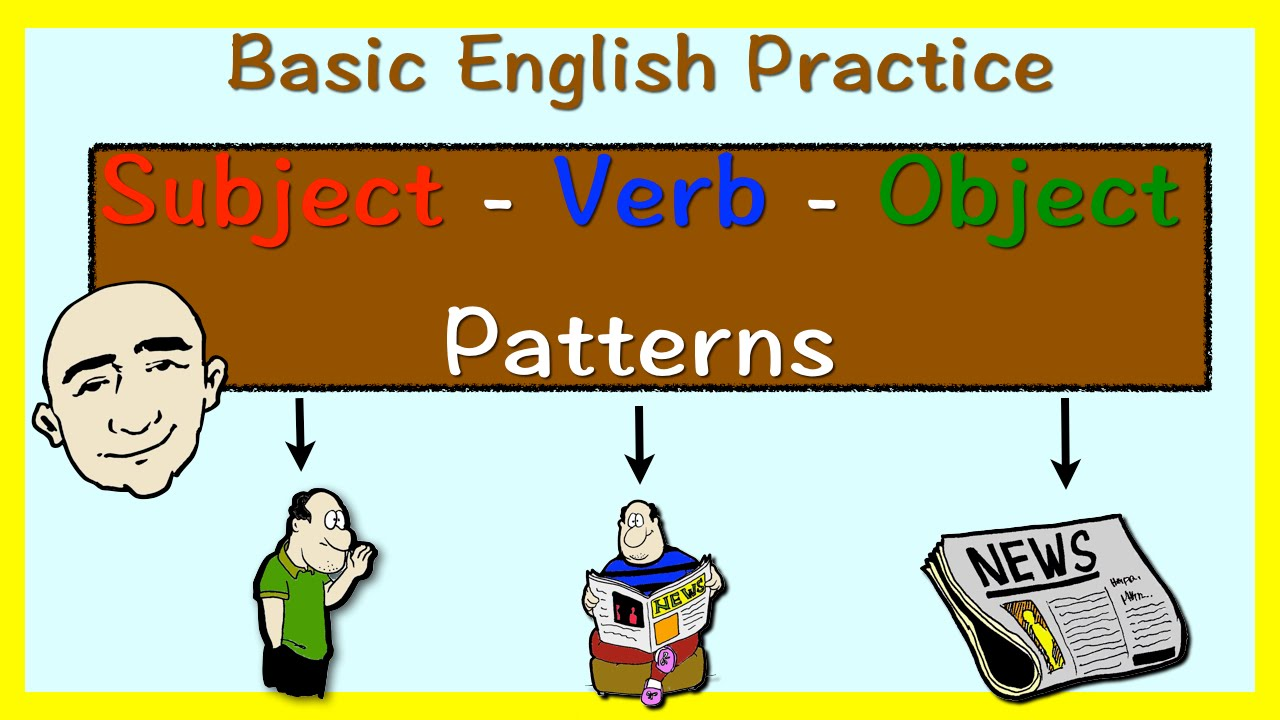
A Complete Beginner-Friendly Lesson
English is an SVO language, which means that in most normal (active voice) sentences, the order is:
Subject → Verb → Object
This structure is the foundation of clear English communication. When learners master SVO, their sentences become more natural, accurate, and easy to understand.
1. What is the SVO Pattern?
Subject (S)
The subject is the person or thing that performs the action.
Examples:
- I
- The teacher
- My friends
- The company
Verb (V)
The verb describes the action or state.
Examples:
- eat
- write
- drive
- study
- open
Object (O)
The object is the person, thing, or idea that receives the action.
Examples:
- rice
- a letter
- the car
- English
- the door
2. How SVO Works in Standard English
Most English sentences follow this simple pattern:
S + V + O
Examples:
- I (S) eat (V) rice (O).
- She (S) watches (V) movies (O).
- They (S) play (V) football (O).
- The manager (S) approved (V) the plan (O).
- We (S) study (V) English (O).
Note: Without the correct SVO order, sentences become confusing.
For example:
Wrong: Eat I rice
Correct: I eat rice.
3. Why SVO Order Is Important
- It helps learners form clear and correct sentences.
- It prevents confusion, especially in professional or academic communication.
- English rarely changes word order, so learning SVO makes learning other tenses easier.
- It supports accurate speaking, writing, and comprehension.
4. SVO in Different Tenses
Present Simple
SVO stays the same.
- He writes emails.
- They play cricket.
Past Simple
Still SVO.
- She watched a show.
- I bought a laptop.
Future Simple
The auxiliary “will” is added, but SVO remains.
- We will start the meeting.
- He will visit his parents.
Present Continuous
Use “be + verb-ing,” but still SVO order.
- I am reading a book.
- They are preparing lunch.
5. Negative SVO Structure
In negatives, “do not / does not / did not” appear after the subject:
S + do/does/did + not + V + O
Examples:
- I do not eat meat.
- He does not like coffee.
- They did not visit the museum.
The SVO order does not change.
6. Questions and SVO
In questions, SVO changes to V + S + O, but in answers, it returns to normal SVO.
Example:
Question: Do you like tea?
Answer: Yes, I like tea.
7. Common Mistakes Students Make
- Putting the object first.
- Wrong: English I study.
- Right: I study English.
- Forgetting the verb.
- Wrong: He an engineer.
- Right: He is an engineer.
- Using two verbs without structure.
- Wrong: She go play.
- Right: She goes to play / She plays.
- Not adding “s/es” for he/she/it.
- Wrong: He eat lunch.
- Right: He eats lunch.
8. Extended Examples
- The students (S) asked (V) a question (O).
- My brother (S) fixed (V) the computer (O).
- The company (S) launched (V) a new product (O).
- We (S) attended (V) the workshop (O).
- I (S) will call (V) the client (O).
9. Exercises (15 Tasks)
Change or write sentences using the correct SVO order.
A. Identify the Subject, Verb, and Object (5 items)
- The cat chased the mouse.
- She reads novels.
- They opened the door.
- My boss sent an email.
- We watched a movie.
B. Rewrite using correct SVO order (5 items)
- Ate he dinner.
- The ball kicked the boy.
- English studying I am.
- Bought yesterday I a phone.
- Homework did they not.
C. Make sentences using SVO (Choose your own words) (5 items)
- Create a sentence about food.
- Create a sentence about work.
- Create a sentence about travel.
- Create a sentence about learning English.
- Create a sentence about family.
10. Answer Key
A. Subject / Verb / Object
- S: The cat | V: chased | O: the mouse
- S: She | V: reads | O: novels
- S: They | V: opened | O: the door
- S: My boss | V: sent | O: an email
- S: We | V: watched | O: a movie
B. Correct SVO Order
- He ate dinner.
- The boy kicked the ball.
- I am studying English.
- I bought a phone yesterday.
- They did not do homework.
C. Sample Answers
- I cooked pasta.
- She finished the report.
- We booked the tickets.
- I practice English daily.
- My sister prepared dinner.