
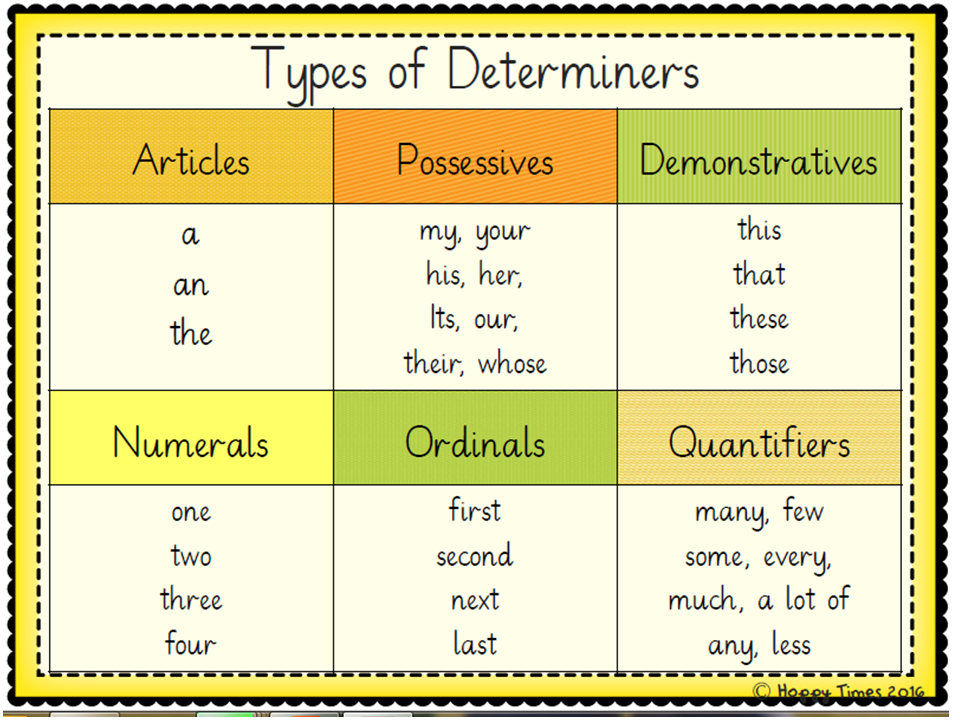
Determiners are words that come before nouns and tell us which one, how many, how much, or whose something is. They help make the meaning of a noun clear and specific.
Without determiners, English sentences often sound incomplete or confusing.
Example:
❌ I have book.
✅ I have a book.
✅ I have this book.
✅ I have my book.
1. What Are Determiners?
A determiner is a word placed before a noun to limit, describe, or clarify it.
Determiners answer questions like:
- Which one?
- How many?
- How much?
- Whose?
Examples
- a car
- the house
- this pen
- my bag
- some water
- three students
2. Types of Determiners
English determiners are grouped into several categories:
- Articles
- Demonstrative Determiners
- Possessive Determiners
- Quantifiers
- Numbers (Numerals)
- Distributive Determiners
- Interrogative Determiners
Each type is explained in detail below.
3. Articles (a, an, the)
Articles are the most common determiners.
a / an (Indefinite Articles)
Used with singular countable nouns when the noun is not specific.
- a before consonant sounds → a car, a university
- an before vowel sounds → an apple, an hour
Examples:
- I saw a dog in the park.
- She is an engineer.
the (Definite Article)
Used when the noun is specific or already known.
Examples:
- Pass me the book on the table.
- The sun rises in the east.
4. Demonstrative Determiners (this, that, these, those)
Used to point to specific nouns.
| Singular | Plural |
|---|---|
| this (near) | these (near) |
| that (far) | those (far) |
Examples:
- This phone is new.
- Those houses are expensive.
5. Possessive Determiners
Used to show ownership or relationship.
| Subject | Determiner |
|---|---|
| I | my |
| you | your |
| he | his |
| she | her |
| it | its |
| we | our |
| they | their |
Examples:
- This is my notebook.
- She lost her keys.
⚠️ its (possessive) ≠ it’s (it is)
6. Quantifiers
Quantifiers tell us how much or how many.
Common Quantifiers
| Countable | Uncountable | Both |
|---|---|---|
| many | much | some |
| few | little | any |
| several | enough | |
| a few | a lot of |
Examples:
- There are many students.
- We have some milk.
- Do you have any questions?
a few vs few / a little vs little
- a few / a little = some (positive meaning)
- few / little = almost none (negative meaning)
Examples:
- I have a few friends. (some friends)
- I have few friends. (almost none)
7. Numbers (Numerals)
Cardinal Numbers (quantity)
- one, two, three…
Example:
- I bought three books.
Ordinal Numbers (order)
- first, second, third…
Example:
- She came first in the race.
8. Distributive Determiners
Used to refer to individual members of a group.
| Determiner | Use |
|---|---|
| each | every individual |
| every | all individually |
| either | one of two |
| neither | none of two |
Examples:
- Each student has a book.
- Every child needs care.
- You can choose either option.
- Neither answer is correct.
9. Interrogative Determiners
Used to ask questions before nouns.
| Word | Use |
|---|---|
| which | choice |
| what | information |
| whose | possession |
Examples:
- Which book do you want?
- What time is the class?
- Whose bag is this?
10. Order of Determiners
When multiple determiners appear, the usual order is:
Determiner → Number → Adjective → Noun
Example:
- My two old books
- Those three red apples
❌ two my books
✅ my two books
11. Common Mistakes
❌ Give me book.
✅ Give me a book.
❌ This are my shoes.
✅ These* are my shoes.*
❌ I have much friends.
✅ I have many friends.
❌ Its my phone.
✅ It’s my phone. / This is my phone.
12. Exercises
A. Fill in the blanks
Choose the correct determiner.
- I have ___ umbrella.
- She lost ___ keys.
- ___ apples are rotten.
- We don’t have ___ time.
- Give me ___ glass of water.
- ___ students passed the test.
- Is this ___ bag?
- He bought ___ two books.
- ___ child deserves love.
- I don’t have ___ money.
B. Choose the correct option
- (this / these) book is interesting.
- She has (much / many) work.
- There are (few / a few) seats left.
- (Which / What) pen is yours?
- He spent (little / a little) money.
- (Every / Each) student was present.
- (Either / Neither) of the answers is correct.
- She drank (some / many) water.
- (My / Mine) brother lives abroad.
- (Those / That) shoes look expensive.
C. Error correction
- She has many money.
- This are my books.
- Give me some advice. (countability)
- Its a beautiful place.
- He doesn’t have few friends.
D. Rewrite using a suitable determiner
- I like book on table.
- I want pen near me.
- Students must submit homework.
- I have friends in Mumbai.
- Bag belongs to her.
13. Answer Key
A. Fill in the blanks
- an
- her
- Those
- much
- a
- Many
- your
- those
- Every
- any
B. Choose the correct option
- this
- much
- a few
- Which
- a little
- Every
- Neither
- some
- My
- Those
C. Error correction
- She has much money.
- These are my books.
- Give me some advice. (correct already)
- It’s a beautiful place.
- He doesn’t have many friends.
D. Rewrite
(Answers may vary)
- I like the book on the table.
- I want this pen.
- All students must submit homework.
- I have some friends in Mumbai.
- This is her bag.