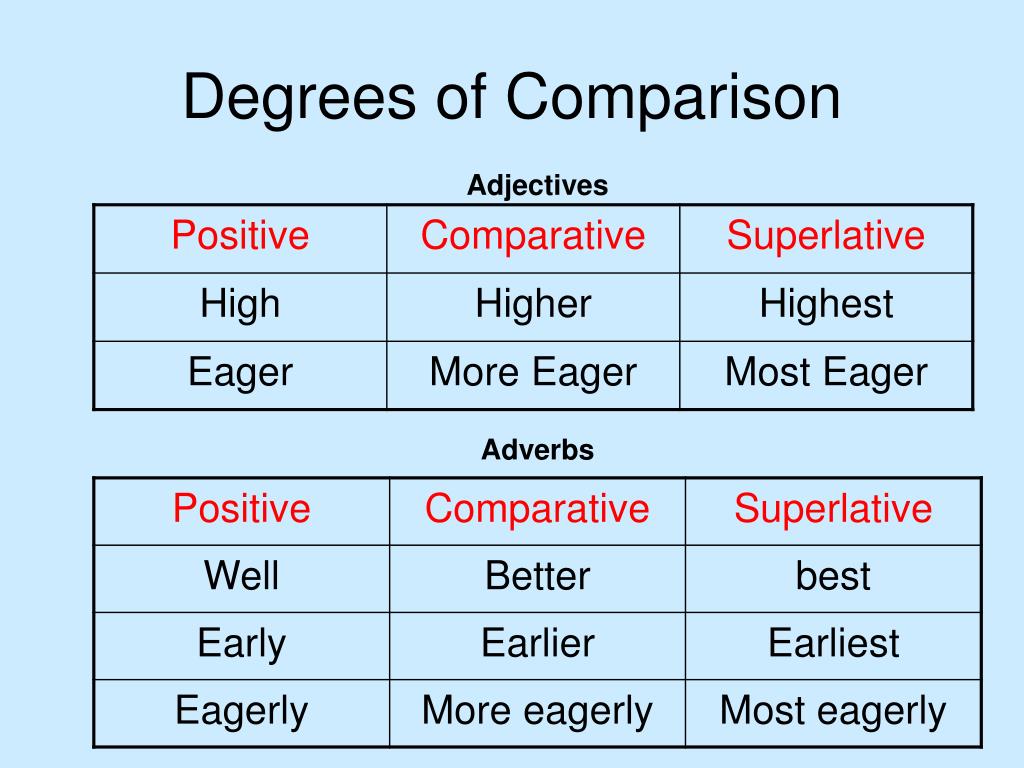
When we compare people, places, things, or actions, we often change adjectives and adverbs to show degree. English uses three degrees of comparison:
- Positive — the base form (no comparison)
- Comparative — compares two things (e.g., bigger)
- Superlative — compares three or more things; shows the highest or lowest degree (e.g., biggest)
This guide explains how to make and use these forms correctly for adjectives and adverbs, with rules, irregulars, comparison structures (than, as…as), and common pitfalls.
1. The Three Degrees — quick overview
- Positive: tall (no comparison)
- Example: She is tall.
- Comparative: taller (comparing two)
- Structure: A is taller than B.
- Example: Rita is taller than Meera.
- Superlative: tallest (one of a group is highest in degree)
- Structure: A is the tallest (in the class).
- Example: Rohit is the tallest in the team.
2. How to form comparatives & superlatives — rules
A. Short adjectives (one-syllable)
Add -er (comparative) and -est (superlative).
- tall → taller → tallest
- short → shorter → shortest
- fast → faster → fastest
Spelling rule: If a one-syllable adjective ends in consonant–vowel–consonant (CVC), double the final consonant before adding -er/-est.
- big → bigger → biggest
- hot → hotter → hottest
B. One-syllable adjectives ending in -y
Change y → i then add -er/-est.
- happy → happier → happiest (but shy → shyer → shyest — both forms shyer/shyest are correct)
C. Two-syllable adjectives
Two cases:
- Many two-syllable adjectives use more / most (especially those not ending in -y).
- peaceful → more peaceful → most peaceful
- careful → more careful → most careful
- If the two-syllable adjective ends in -y, it often takes -er/-est (change y→i):
- happy → happier → happiest
- angry → angrier → angriest
Some two-syllable adjectives (e.g., simple, clever, narrow, quiet) can take either pattern (both forms are acceptable), but style guides often prefer more/most for many two-syllable words in formal writing.
D. Adjectives with three or more syllables
Use more / most.
- beautiful → more beautiful → most beautiful
- interesting → more interesting → most interesting
E. Adverbs
- Adverbs that look like adjectives and end in -ly use more / most:
- carefully → more carefully → most carefully
- Short adverbs (one-syllable) can use -er/-est:
- fast → faster → fastest (used both for adjective and adverb)
- Adverbs like well are irregular (see section on irregulars).
3. Comparative structures (how to use)
A. Comparing two things (comparative)
- Structure:Subject + comparative + than + noun/pronoun
- She is taller than her sister.
- This book is more interesting than that one.
B. Comparing three or more (superlative)
- Structure:Subject + the + superlative + (in/among) + group
- He is the fastest in the team.
- This is the most expensive item among the watches.
C. Equal comparison (equality)
- as + adjective/adverb + as
- She is as tall as her brother.
- He drives as carefully as her.
D. Inequality (less)
- less + adjective/adverb + than
- This problem is less serious than the previous one.
- He speaks less clearly than before.
E. Negative comparison (not as / not so)
- not as/so + adjective/adverb + as
- This phone is not as good as the new model.
4. Irregular comparatives & superlatives
Some common adjectives/adverbs change form irregularly:
| Positive | Comparative | Superlative |
|---|---|---|
| good | better | best |
| well (adv) | better | best |
| bad | worse | worst |
| far | farther / further | farthest / furthest |
| little (amount) | less | least |
| much / many | more | most |
| old | older / elder | oldest / eldest |
Notes:
- farther usually for physical distance; further for figurative or additional extent. Both are often used interchangeably in casual writing.
- elder/eldest is used with people (family relationships) in place of older/oldest in some contexts (e.g., my eldest sister).
5. Special rules and exceptions
A. Do not use more/most with -er/-est adjectives
Wrong: more taller — correct: taller.
B. Do not add -er/-est to adjectives that already have them (double comparatives)
Wrong: more better — correct: better.
C. Use the with superlatives
- She is the smartest student.
But if you use most in an absolute expression: He is (one of) the most talented actors.
D. Comparatives with quantifiers & determiners
- much, far, a lot can intensify comparatives: much better, far more interesting, a lot cheaper.
E. When comparing nouns rather than qualities
If you compare nouns in quantity, not the adjective, structure differs:
- John has more cars than Mark. (Here more modifies a noun, not an adjective.)
F. Double comparatives (avoid)
Avoid informal phrases like more better, more happier. Instead use better or happier.
G. With negative adjectives
- less + adjective is used to decrease degree: less expensive, less beautiful.
6. Comparatives with adjectives that have two acceptable forms
Some adjectives allow both -er/-est and more/most depending on degree of formality or emphasis.
Examples:
- clever → cleverer / more clever → cleverest / most clever (both forms acceptable; more clever less common)
- simple → simpler / more simple (both used)
When in doubt for a two-syllable adjective, more/most is always safe in formal writing.
7. Comparisons with adjectives + noun (superlatives describing groups)
- He is the best of the three students.
- She is the most hardworking of the employees.
Use of or in depending on group representation: of for smaller sets, in for larger or general contexts.
Examples:
- John is the tallest of the three brothers.
- She is the most experienced lawyer in the firm.
8. Comparative & superlative with adverbs
- Many adverbs form comparatives with more/most: quickly → more quickly → most quickly
- Short adverbs can add -er/-est: fast → faster → fastest
- Irregular: well → better → best; badly → worse → worst.
Use adverb comparison to compare actions:
- He runs faster than I do.
- She speaks more clearly than her sister.
9. Common mistakes & how to avoid them
- Using -er with multi-syllable adjectives incorrectly
- Wrong: more beautifuler
- Right: more beautiful / most beautiful
- Omitting “than” after comparative
- Wrong: She is taller me.
- Right: She is taller than me.
- Using “the” with comparatives
- Wrong: He is the taller than his friend.
- Right: He is taller than his friend.
- Confusing adjective vs adverb comparison
- Wrong: She sings beautiful.
- Right: She sings beautifully.
- Comparative: She sings more beautifully than him.
- Comparing two things with superlatives
- Wrong: Between the two, John is the tallest.
- Right: Between the two, John is taller.
- Use superlative for three or more: John is the tallest of the three.
10. Useful comparison structures & examples
A. Comparative + than
- Tom is older than Jerry.
- This exam was more difficult than the last one.
B. as + adjective/adverb + as (equality)
- She is as brave as a soldier.
- He doesn’t run as fast as her.
C. not as/so + adjective/adverb + as (inequality)
- This phone is not as cheap as the other.
- He sings not as well as she does.
D. The + comparative, the + comparative (correlative comparatives)
Used to show two linked changes: The more…, the more…
- The more you practice, the better you become.
- The earlier we leave, the sooner we arrive.
E. Comparative with verbs of preference
- I prefer tea to coffee. (not a degree form but comparison of preferences)
- I would rather stay home than go out.
11. Irregular list — common adjectives & adverbs
| Positive | Comparative | Superlative |
|---|---|---|
| good | better | best |
| bad | worse | worst |
| far | farther / further | farthest / furthest |
| little (amount) | less | least |
| much / many | more | most |
| old | older / elder | oldest / eldest |
| well (adv) | better | best |
Memorize these irregulars — they are very common.
12. Exercises
Instructions: For exercises 1–20, write the comparative form (for two-item comparisons) or superlative when indicated. Use correct spelling. For exercises 21–30, complete sentences with the correct form (comparative, superlative, or equality structure). Answers follow.
A. Form the comparative or superlative
Write the comparative for 1–10; write the superlative for 11–20.
- large → ______
- happy → ______
- clever → ______
- hot → ______
- beautiful → ______ (comparative)
- busy → ______
- good → ______
- difficult → ______ (comparative)
- early → ______ (comparative)
- thin → ______
- small → ______
- sad → ______
- tall → ______
- interesting → ______ (superlative)
- old → ______ (superlative)
- expensive → ______ (superlative)
- bad → ______ (superlative)
- fast → ______ (superlative)
- well (adv) → ______ (superlative)
- little (amount) → ______ (superlative)
B. Complete the sentences
Choose the correct comparative/superlative form or structure.
- My house is (big) ______ than yours.
- Among the three brothers, Manu is the (young) ______.
- This exam was (easy) ______ than I expected.
- She sings (good) ______ than her sister.
- This problem is (serious) ______ than the last one.
- He is not as (tall) ______ as his father.
- Of all the students, Priya is the (intelligent) ______.
- The more you practice, (good) ______ you become.
- Summer is (hot) ______ in India than in England.
- Which city is (large) ______, Mumbai or Delhi?
13. Answer key
A. Comparative / Superlative forms
- large → larger
- happy → happier
- clever → cleverer (or more clever) — cleverer is common
- hot → hotter
- beautiful → more beautiful (comparative)
- busy → busier
- good → better (irregular)
- difficult → more difficult
- early → earlier
- thin → thinner
- small → smallest
- sad → saddest
- tall → tallest
- interesting → most interesting
- old → oldest (or eldest in family context)
- expensive → most expensive
- bad → worst
- fast → fastest
- well → best
- little (amount) → least
B. Sentence completions
- My house is bigger than yours.
- Among the three brothers, Manu is the youngest.
- This exam was easier than I expected.
- She sings better than her sister.
- This problem is more serious than the last one.
- He is not as tall as his father. (or not as tall as)
- Of all the students, Priya is the most intelligent.
- The more you practice, better you become. (Complete correlative: the better you become — full: The more you practice, the better you become.)
- Summer is hotter in India than in England.
- Which city is larger, Mumbai or Delhi?